By Evelyn Sinclair, Staff Writer
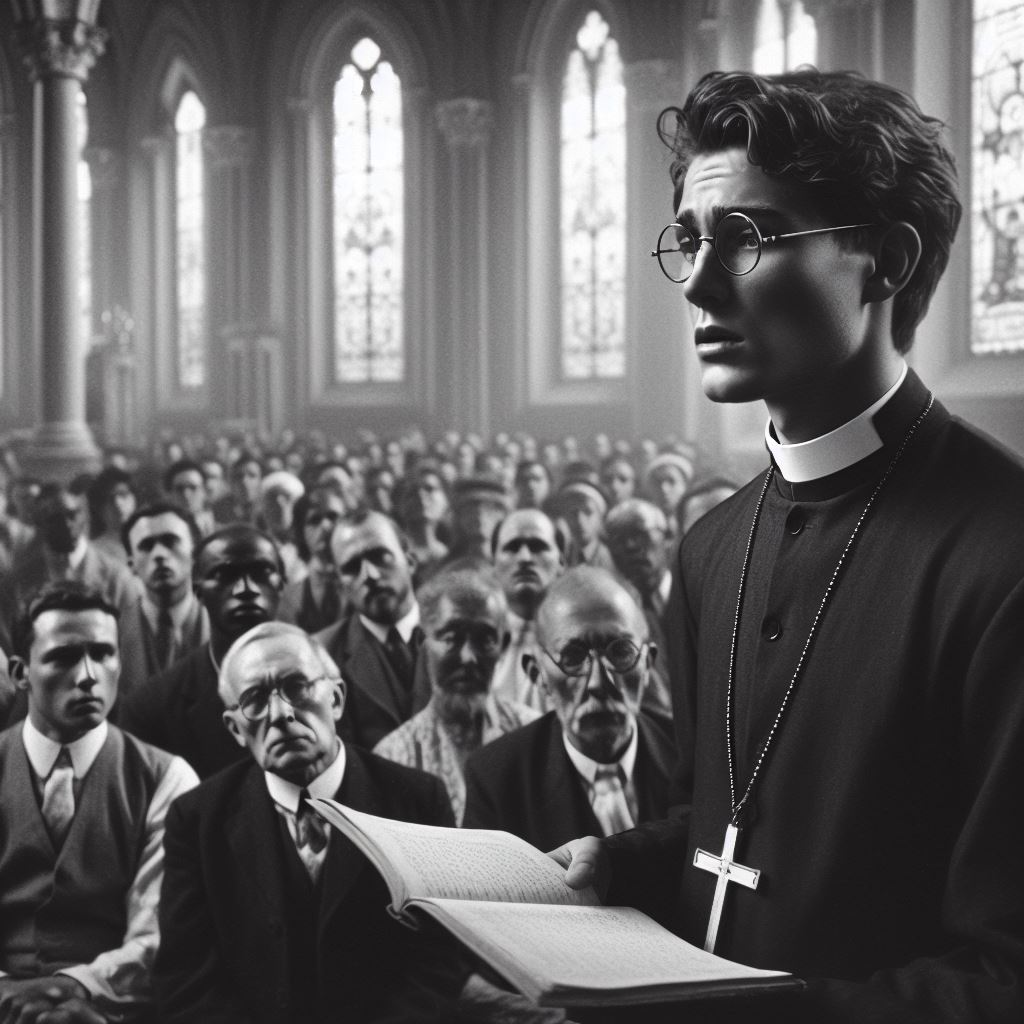
May 24, 1920, New York City — In the wake of the harrowing news surrounding the Carlyle Expedition Massacre in Africa, the venerable Father Molokai addressed his parishioners at St. Agnes Church yesterday evening. The dimly lit sanctuary, adorned with flickering candles, bore witness to the somber gathering as the young priest, known for his contemplative demeanor and round spectacles, stepped up to the pulpit.
The Carlyle Expedition, led by the enigmatic millionaire playboy Roger Carlyle, had embarked on a mysterious quest across the African continent. Their goals remained shrouded in secrecy, even to those who should have been privy to the details1. However, tragedy struck when news arrived that the expedition had met a gruesome end near Nairobi. The details were scarce, but rumors of debauchery and worse circulated among the city’s elite and those who followed the exploits of the Carlyle family.
Father Molokai, with his gentle yet resolute voice, addressed the congregation. His black cassock seemed to absorb the dim light, emphasizing the gravity of the moment. “My dear brothers and sisters,” he began, “we gather here today not only as a community but as a family united in grief. The loss of our fellow New Yorkers on the Carlyle Expedition weighs heavily upon our hearts.”
He paused, allowing the silence to settle. The Empire State Building, visible through the stained glass windows, stood tall against the evening sky, a symbol of resilience and hope. Father Molokai continued, “In times of darkness, we turn to our faith for solace. Let us remember those brave souls who sought answers beyond our city’s borders. Their quest may have ended tragically, but their spirit lives on.”
The congregation listened intently, their eyes fixed on the young priest. Father Molokai invoked the memory of the fallen explorers, urging his parishioners to find strength in their shared sorrow. “As we mourn, let us also celebrate their courage,” he said. “They dared to venture into the unknown, seeking truths that elude most of us. May their sacrifice inspire us to seek our own paths, to explore the mysteries of our existence.”
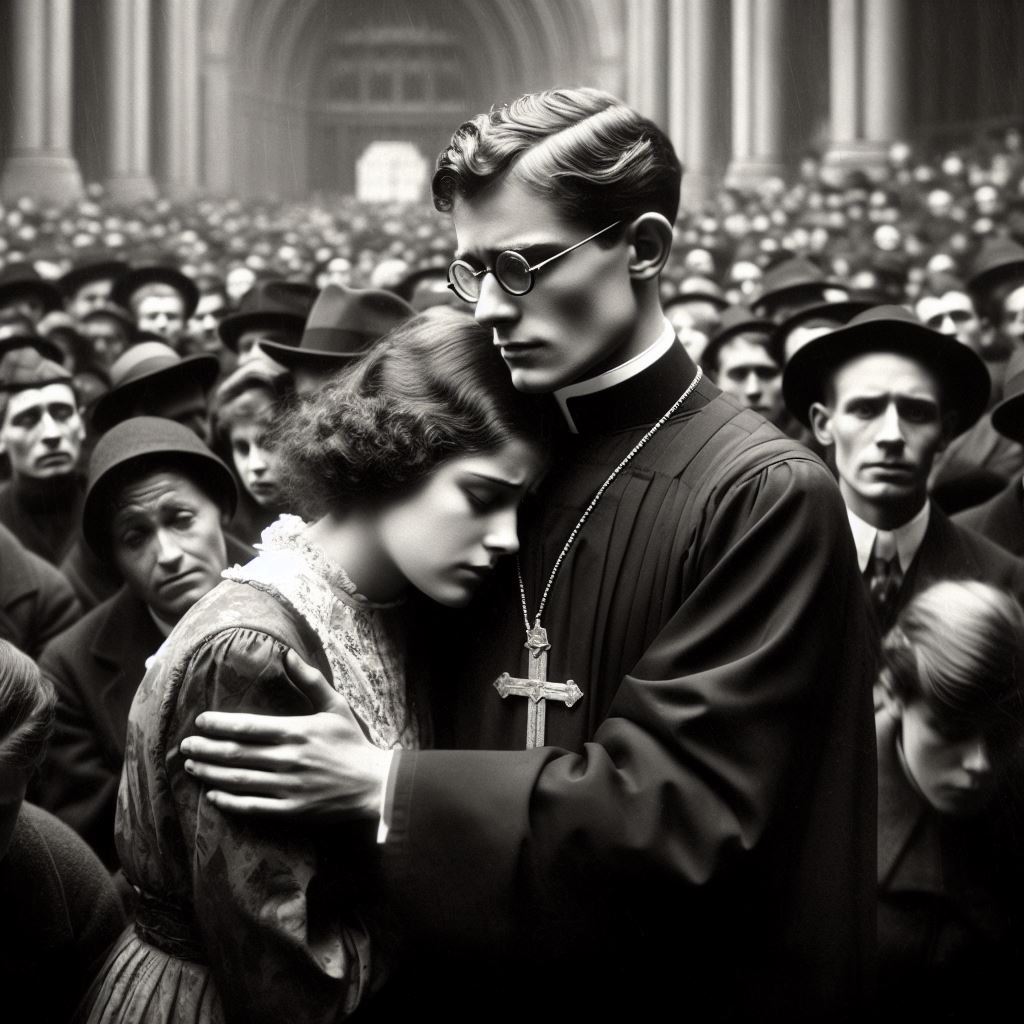
Outside, the bustling streets of 1920s New York City carried on, oblivious to the grief within the church walls. The sounds of carriages, distant horns, and the occasional jazz tune seeped through the heavy oak doors. But inside, Father Molokai’s words resonated—a balm for wounded souls.
As the congregation filed out, some wiping tears from their eyes, Father Molokai remained at the pulpit. His contemplative expression hinted at deeper thoughts, perhaps questions about the nature of fate and the purpose of human endeavors. The Empire State Building, illuminated against the night sky, stood as a silent witness to the priest’s consoling words.
And so, in the heart of the city that never sleeps, Father Molokai offered solace to a grieving parish, bridging the gap between the earthly and the unknown—a beacon of hope in a world still reeling from the Carlyle Expedition Massacre.
1: For more information on the Carlyle Expedition and its ill-fated journey, see “Roger Carlyle: Leader of the Carlyle Expedition and millionaire playboy” on World Anvil. 2